
In today’s fast-paced product development landscape, the Product Operating Model (POM) emphasizes close collaboration between the Product Trio – Product Manager, Designer, and Engineer – and the Customer to solve real problems efficiently. Artificial Intelligence (AI) is transforming this model by supercharging creativity, planning, and execution. While there are countless ways of leveraging AI in the Product Operating Model, let’s explore three standout ways that can dramatically boost your dual-track process of discovery and delivery.
What other innovative uses have you discovered?
1. Vibe-Coded Prototypes for Dynamic Discovery Sessions
At the heart of POM’s discovery phase lies direct collaboration with the Customer to unearth viable solutions. A proven tactic here is building throwaway prototypes – quick, low-fidelity mocks that spark essential risk discussions:
- Valuable? Does it truly address the customer’s pain point?
- Viable? Does it align with our business goals and product vision?
- Usable? Is it intuitive and effortless?
- Feasible? Can we build it within our tech constraints?
Enter “vibe coding”: a rapid AI-driven method to whip up these prototypes, showcasing A/B variations for immediate feedback. Imagine prompting your AI tool like this:
“Using the current codebase, update the scheduling window to include two new fields: reroute preference and legality status. Add a mock callback displaying ‘success’ when reroute preference is selected. Randomize the legality status field with options like ‘legal,’ ‘illegal,’ or ‘reserve.’ Relocate related fields a, b, c, and d into a highlighted bottom section for better organization. Save as Option A.”
“Using the current codebase, add a Reroute Preference button to the scheduling window. On click, display an overlay with two new fields: reroute preference and legality status. Include a mock ‘success’ callback for reroute selection and randomize legality status (‘legal,’ ‘illegal,’ ‘reserve’). Save as Option B.”
With these prototypes in hand, your next discovery session becomes a lively brainstorming ground. Customers can interact, critique, and even inspire refinements – prompting another quick AI iteration. Remember, discovery isn’t about perfection; it’s about converging on a direction! Vibe coding gets you there faster, turning abstract ideas into tangible options.
2. Jumpstarting Features and Stories for Seamless Planning
Though not a core POM ritual, many teams bridge discovery to delivery by outlining features and user stories through techniques like story mapping, MVP sizing, or story workshops. This step carves out incremental value slices, ensuring steady progress.
AI shines here by generating an initial blueprint of features and stories based on your chosen solution, priming your team for collaborative refinement. A tailored prompt might look like:
“The customer favors Option A: integrating the two new fields directly into the scheduling window. Generate a set of Features and User Stories. Each Feature must be valuable, independently releasable (with minimal dependencies), and include a description, benefit hypothesis, and high-level acceptance criteria. Each Story needs a concise description, acceptance criteria, and adherence to INVEST principles (Independent, Negotiable, Valuable, Estimable, Small, Testable). Incorporate Enabler Features/Stories for necessary prep work, and flag any dependencies for discussion.”
This output isn’t gospel – treat it as a catalyst. Rally your Product Team to probe: “Does this capture our vision? What’s missing? Anything extraneous?” The result? A richer, team-vetted plan that accelerates from concept to execution.
3. Rough-Cut Code and Tests to Fuel Delivery
With a solution locked in, it’s time to build. AI can deliver a solid “rough cut” of production-ready code and tests, slashing initial drafting time while upholding standards.
Consider this prompt for implementation:
“Implement Option A in code, adhering to our Coding Standards (attached). Use the Complexity Analysis tool to ensure no increase in cyclomatic complexity. Trigger the eventing API on reroute preference changes to notify other subsystems. Display standard Success/Error Alerts accordingly. Include comprehensive unit tests integrated into our CI pipeline, plus end-to-end functional tests for reroute preference and legality status in the master test suite.”
Of course, AI lacks your team’s full context, so rigorous review is non-negotiable. Scrutinize for quality, architecture fit, and edge cases – then iterate. This approach doesn’t replace human ingenuity; it amplifies it, getting you to a testable build in record time.
Wrapping Up: AI as Your POM Turbocharger
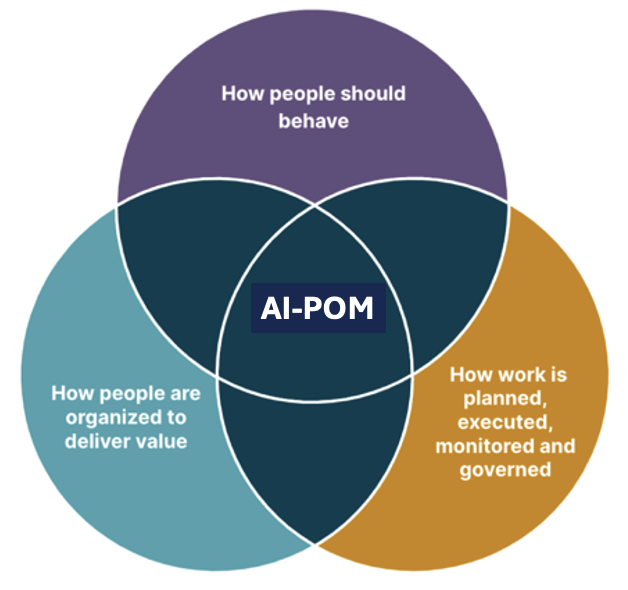
By embedding AI across discovery, planning, and delivery, you’ll supercharge POM’s dual-track agility – faster prototypes, smarter backlogs, and quicker code cycles. The key? Use AI as a collaborator, not a crutch: always validate, refine, and infuse your expertise.
How are you harnessing AI in your product workflows? Share your tips or unconventional hacks below – let’s crowdsource the next big evolution in POM!
Explore these resources for more insights:
Good luck on your journey to a leaner, more effective use of AI!